The weird & wonderful secrets hidden beneath Brighton Royal Pavilion
The Royal Pavilion in Brighton is perhaps the most famous of all Brighton’s attractions, and a lot of people who go to see it spend the whole time looking up. The iconic onion domes, the huge chandeliers, and the jaw-dropping chinoiserie interiors are enough to give anyone a stiff neck.
As fascinating as all these features are, there’s a whole other story right beneath your feet that a lot of visitors never find out about. Secret tunnels, air raid shelters, and a King with a rather embarrassing secret have all left their mark on the lesser-known history of Brighton’s most iconic landmark.
Here’s a closer look at some of the weird and wonderful secrets hidden beneath Brighton Royal Pavilion.
George IV: A king and his monument
Before we dig into some of the lesser-known stories about the pavilion, it helps to understand a bit about the man responsible for its being there in the first place. Read just a little about George IV, and you’ll quickly see the pavilion’s unique and eccentric profile is a reflection of the man who commissioned it.
George first visited Brighton as the Prince of Wales in 1783, when he was just 21 years old. After a period of rapid population growth thanks to a doctor with some odd ideas about the benefits of drinking seawater, Brighton already had a reputation for being a little chaotic and bohemian. It suited the young prince perfectly.
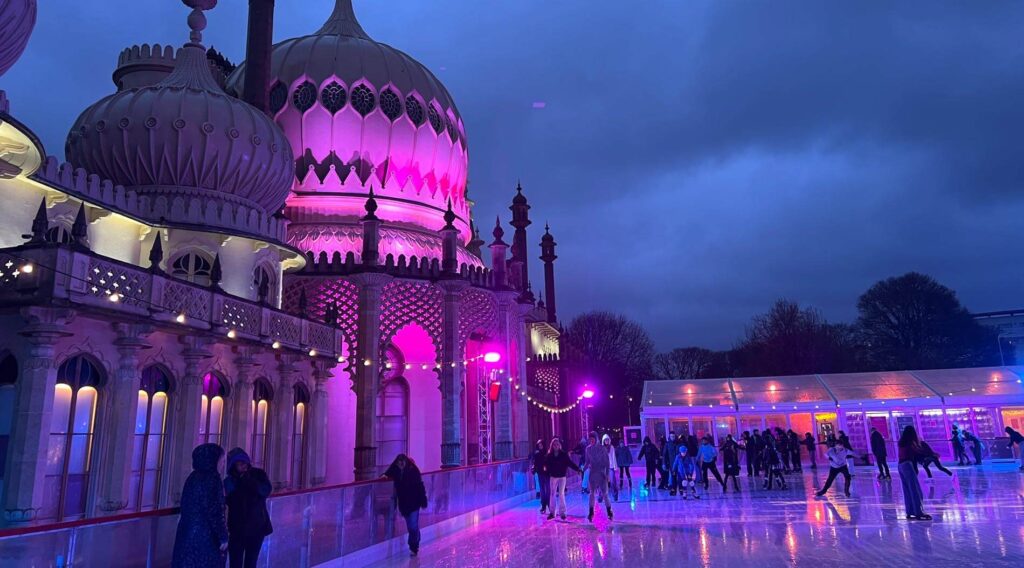
After renting a modest home overlooking Old Steine, George commissioned some of the most renowned architects of the time to transform it into the dazzling Brighton Pavilion we know today – a mish-mash of Indo-Islamic architectural styles imported via British colonialism, more than a little unorthodox for a royal residence on the Sussex coast.
As if building himself a palace wasn’t enough, George was also one half of one of the most scandalous romantic entanglements of the Regency era.
A not-so-secret marriage
The following sounds like something out of a period drama, but every word of it’s true.
In December 1785, the Prince of Wales secretly married Maria Fitzherbert in the drawing room of her London home. Maria had a full bingo card of reasons that made her an unsuitable match for the prince: twice-widowed, Catholic, and six years George’s senior.
All that aside, the marriage was illegal on a couple of fronts. First, under the Act of Settlement, no monarch could marry a Catholic, a kind of insurance policy against the national turmoil that was kicked up during the English Reformation and Civil Wars. Second, the Royal Marriages Act required the King’s consent. George did not mention his plans to marry Maria to his dad.
The newlyweds settled in Brighton, and despite having to live in secrecy, the couple were “a picture of romantic contentment”, according to the magazine Royal Romances. Mrs Fitzherbert’s house, Steine House, was just a short walk from Brighton Pavilion, and together the two lovers enjoyed being a part of regency high society in an up-and-coming city.
Sadly, their love wasn’t meant to last. George’s family quickly found out about the not-so-secret marriage, and he was pressured into agreeing to a formal, Protestant marriage to his cousin Caroline of Brunswick, in 1795. Part of the convincing came in the form of an offer from Parliament to clear his debts of £600,000.
As much as the royals would have loved to keep it hush hush, Maria’s connection to Brighton Pavilion is still acknowledged throughout the building.
This brings us to the legend about the Brighton tunnels.
Sign up to the Brighton newsletter
The Tunnel: fact and fiction
If you’re a Brighton local, you may have heard the story about how George IV had a secret tunnel built under Brighton Pavilion so he could sneak out and visit Maria Fitzherbert. It’s a great story that adds a little more intrigue to our regency drama. Sadly, like a lot of great legends, it simply isn’t true.
The fact of the matter is the relationship between George and Maria was common knowledge. While there was a tunnel underneath the Pavilion, it was constructed well after their relationship had ended.
Dan Cox, head guide from Brighton & Hove Museums explains:
“ There was nothing secret about their relationship. When Mrs. Fitzherbert came to the Royal Pavilion, she came in with her pomp. Nobody could be under any impression that she wasn’t coming. There was never a tunnel from here to Mrs. Fitzherbert’s house. ”
So, why build the tunnel in the first place? Sorry to disappoint, but the truth isn’t so much scandalous as it is sad.
When the tunnel was commissioned, George had become morbidly overweight and crippled by gout, which made him embarrassed to be seen in public. The 60-metre tunnel in fact connected the Pavilion to the Royal Stables, which are now the Brighton Dome and Brighton Museum. George IV loved riding, horse racing and breeding, even for a member of the aristocracy. The tunnel served as a way for him to reach his beloved animals without having to cross Pavilion gardens and risk being seen by his subjects.
The Pavilion at war
The scandal around Brighton Pavilion mostly ended with George’s death in 1830, but the pavilion would soon take another turn and leave another compelling mark on local history.
In 1914, at the outset of the First World War, the Royal Pavilion was transformed into a hospital, specifically for Indian soldiers wounded on the Western Front. Brighton’s reputation as a health resort made it a logical choice for recovery, but there was also a symbolic dimension, as higher-ups in the military hoped that caring for Indian soldiers in a royal residence would reflect positively on the British Empire back in India, where a movement for independence was already taking shape.
In a feverish development, the now-famous Brighton landmarks of the Pavilion, Dome, and Corn Exchange were converted into a state-of-the-art medical facility in less than two weeks. The authorities running the project also took considerable care with catering to cultural and religious needs, with separate kitchens for different faiths, designated places of worship, and appropriate funeral arrangements for Hindu, Sikh, and Muslim troops. The Indian hospital was closed in 1916, but the Pavilion continued to operate as a rehabilitation centre for war amputees, and treated over 6,000 soldiers who’d lost limbs in the war.
Later, during the Second World War, the vaulted wine cellars beneath the Pavilion were repurposed as air raid shelters and fitted with bunk beds for locals to shelter from attacks by the Luftwaffe.
How to see it for yourself
This iconic palace has been through a lot over the years, and the brilliant thing is you can still see it today, with Royal Pavilion tours giving you the opportunity to walk in the footsteps of the most significant figures from its story. The Brighton Pavilion tour promises a fascinating level of detail and great value for money, standing out as one of the best Brighton attractions for anyone curious about lesser-known episodes of British history.
The Basement & Tunnel Tour runs on selected Tuesdays and Saturdays from May to August, taking you through the servants’ quarters and WWII air raid shelter, then ends with a walk through the tunnel itself, emerging in the Brighton Museum. This tour includes entry into the Pavilion, making it one of Brighton’s best places to visit if you’re looking to wrap two experiences into one.
The Behind Closed Doors Tour provides an exclusive look into the lives of the Pavilion’s inhabitants, both public and private, taking you through lavish habitations and up hidden staircases, letting you explore the contrast between royal luxury and the hard lives of the servants.
For families, the main Pavilion rooms are brilliant for things to do in Brighton with kids. The sheer scale and decorative excess gets a real reaction out of the little ones, and the story of a prince’s forbidden love spins naturally into a fairytale.
The little-known Brighton underground world beneath the Pavilion is truly fascinating, and one of the city’s many underrated gems. If you’ve passed the palace and its gardens countless times, take a moment to step inside – you won’t regret it!
For more fascinating tidbits of Brighton’s history and guides on Brighton attractions, be sure to follow us on social media, or subscribe to our email newsletter today.
Learn more about Brighton's rich history
If the Royal Pavilion has sent you down a bit of a Brighton history rabbit hole, learn about how a fishing village became the city of Brighton or find out what life was really like inside Preston Manor all those years ago.
If your next Brighton trip is more about cocktails than secret corridors, our Brighton hen do guide has you covered.
Popular questions asked & answered
Are there tunnels under the Royal Pavilion in Brighton?
Yes! The Royal Pavilion in Brighton has underground tunnels and service passages beneath it. One in particular was used by George IV to get to and from the royal stables without being seen by the public, though there’s a long-standing legend that it was for him to visit Maria Fitzherbert in secret.
Who used to live in the Brighton Pavilion?
Brighton Pavilion was originally designed as a seaside retreat for George IV when he was still Prince of Wales, and his successor, William IV, is also known to have used it. Though Queen Victoria owned it briefly, she disliked its lack of privacy and sold it to the local government in 1850.
Why was the Royal Pavilion built?
George, then Prince of Wales, first came to Brighton for its sea air and purported health benefits, and quickly fell in love with the city. He commissioned a series of architects to develop a modest farmhouse overlooking Old Steine into the extravagant palace it is today.
What architectural style is the Royal Pavilion?
The Brighton Royal Pavilion has a distinctive Indo-Saracenic exterior inspired by Indian Mughal architecture, contrasted by Chinese-inspired interiors. Though several architects developed the building, most of what we see now is the work of John Nash.